
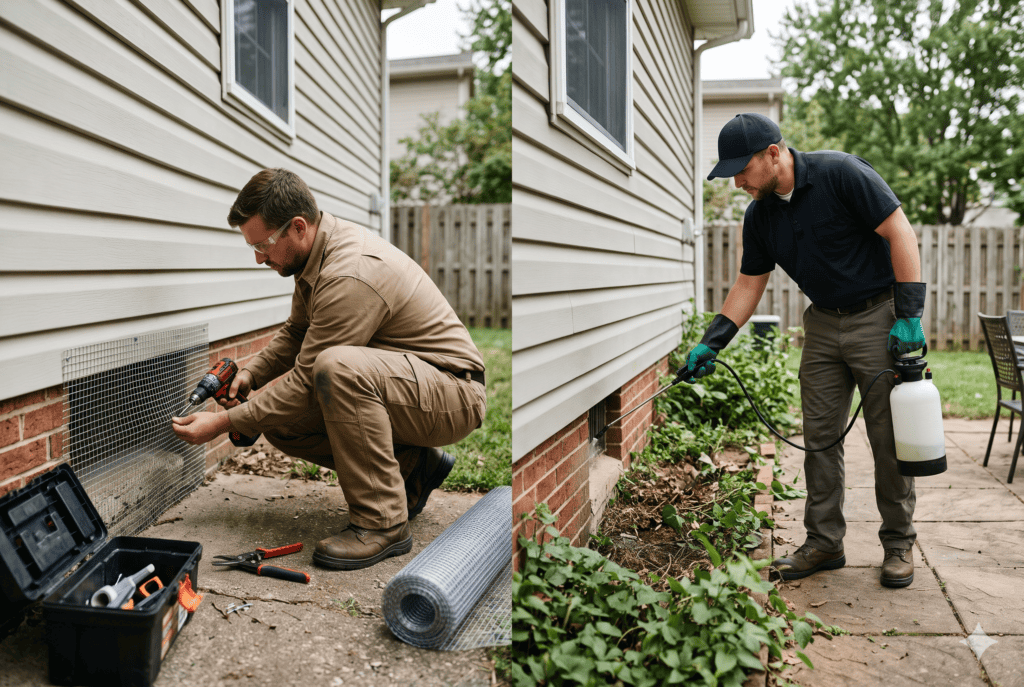
Pest treatment controls an infestation, while pest exclusion closes the openings pests use to enter your home. You may need both if pests are already inside and entry points remain open. But how do you know whether treatment alone will be enough, or whether repairs belong in the plan? Before booking professional pest control companies and exterminators in Tacoma, Lacey, Gig Harbor, Lakewood, Olympia, or the surrounding communities, here’s what to look for and ask so you understand what your home actually needs.
What Does Pest Treatment Address?
Pest treatment controls an identified pest using methods suited to its behavior and location. Depending on the infestation, that might mean traps, baits, or targeted pesticide applications. It can also help prevent activity, not just remove pests that are already indoors.
The EPA’s Integrated Pest Management guidance places identification, monitoring, and prevention alongside control. Identifying the pest helps you avoid unnecessary pesticide use or choosing a product that doesn’t address the problem.
A good treatment recommendation should explain:
- Which pest is present. An ant trail shows activity, but knowing the species helps you decide where to investigate and how to respond.
- Where treatment is needed. Pests seen near a food source may be nesting elsewhere, so treating the sighting location alone may miss the source.
- How progress will be checked. New droppings, continued sightings, or fresh damage can show whether more attention is needed.
- What preparation is required. Access instructions and restrictions around treated areas should match the service being performed.
If you’re comparing pest control companies in Tacoma, Lacey, and Gig Harbor, a recommendation that covers these four points is a good sign.
At Long Pest Control, our ant control service includes inspecting the property, identifying activity and nesting locations, and recommending treatment. Our services cover carpenter ants, moisture ants, pavement ants, and odorous house ants.
Before the appointment: Note where pests appear, when the activity began, and whether anything changed after previous treatment.
What Does Pest Exclusion Address?
Pest exclusion reduces access by repairing or sealing openings that pests can use to enter a home. The work addresses gaps in the building, not the pest population itself.
Small openings matter more than you’d think. The CDC reports that mice can fit through a hole about ¼ inch across, roughly the width of a pencil. A gap doesn’t have to look big to let them in.
An inspection may examine:
- Utility penetrations: Spaces around plumbing, electrical, cable, and gas lines.
- Attic and crawlspace vents: Damaged screening or gaps around the vent.
- Doors and windows: Openings around frames or missing weather stripping.
- Foundation and roofline areas: Gaps around the lower structure, eaves, and other building edges.
These areas need assessment, not indiscriminate sealing. Repairs should suit the pest and opening while preserving necessary ventilation and the building component’s function.
Homeowners arranging pest control in Lakewood, Olympia, and Puyallup should expect the inspection to cover these areas, not just the spot where pests were seen.
Long Pest Control’s exterior exclusion service includes identifying entry points around the home’s understructure, perimeter, and foundation. If the inspection reveals extensive foundation, roof, siding, window, or door repairs beyond our scope, we’ll let you know so you can arrange the work with a licensed contractor.
Pest Exclusion vs. Pest Treatment: The Practical Differences
Treatment manages pest activity, while exclusion limits entry through the building. Both can help prevent problems, but they do different work.
| What you need to know | Pest treatment | Pest exclusion |
| Primary purpose | Control identified pest activity | Reduce access through building openings. |
| Typical work | Trapping, baiting, or targeted applications | Repairing or sealing identified entry points |
| What may remain unresolved | Openings allowing continued access | Pests or colonies already established inside |
| How progress is assessed | Changes in sightings, captures, or other evidence | Completed repairs and remaining access points |
| When both may be appropriate | Pests are established inside | Those pests also have an identified way into the home |
An exterior pesticide application won’t fix a damaged vent, and repairing the vent won’t tell you whether rodents are still living beneath the house. That’s why your estimate should show what each service includes.
When Should You Choose Treatment, Exclusion, or Both?
Choose treatment, exclusion, or coordinated work according to the pest evidence and inspection findings. Recurring activity alone doesn’t prove an opening caused the problem.
When you’re talking with pest exterminators in Federal Way, Auburn, or University Place, these situations are a useful starting point:
- Pests are active, but their source is unclear. Identification and investigation should guide treatment. Sealing a suspected gap may accomplish little if the infestation began elsewhere.
- An opening exists without confirmed indoor activity. Exclusion may be appropriate as prevention after the affected area has been checked.
- Rodents are indoors, and an entry point is identified. Control and exclusion should work together, so the remaining rodents are dealt with and new ones can’t get in.
- Activity returns after treatment. Your technician should look for possible nesting areas, access points, and conditions that support the pest.
For example, droppings beside a crawlspace opening suggest a need to investigate both activity and access. Closing the opening addresses one concern, but the technician must also assess whether rodents remain beneath the home.
The CDC’s trapping guidance uses one week without captures and without new signs as an indicator that rodents have been removed. That’s general monitoring guidance, not a guaranteed timeline for any individual property.
Ask before work begins: “How will you decide when to seal the openings, and how will you check whether pests remain inside?”
Which Pests May Need Both Services?
Rodents and some ant infestations may need treatment alongside exclusion, while other pest problems require a different approach to the source. After all, not every infestation begins through an exterior opening.
| Pest | What treatment addresses | Where exclusion or other prevention fits |
| Rats and mice | Rodents already present and continuing activity | Closing entry points and limiting accessible food |
| Carpenter ants | The infestation and relevant nesting areas | Reducing access and investigating moisture or damaged wood |
| Other household ants | The identified species and nesting locations | Addressing openings, food sources, and moisture |
| Food and fabric pests | Infested products or materials and the source | Exterior sealing may not resolve pests introduced with affected items |
The EPA explains that pests dependent on people for food, water, and shelter require integrated management. Closing an opening leaves part of the problem unresolved if those resources remain available.
At Long Pest Control, we offer rodent, ant, termite, spider, and food and fabric pest services. The right combination depends on the pest and what we find, not on a standard repair package for every infestation.
What Happens During an Exclusion Inspection?
An exclusion inspection identifies possible entry points, documents conditions encouraging pests, and establishes which repairs are appropriate. The technician should show what needs repairing and explain why.
When our pest exterminators inspect homes in Federal Way, University Place, Puyallup, Auburn, WA, and the surrounding localities, we provide photographs, a house diagram showing approximate entry-point locations, and a bid for the recommended exclusion work. Your technician should show you what needs repairing and explain why.
Use that documentation to clarify:
- Where pests may be entering. Ask whether the opening is just a possible route or whether pest evidence was found nearby.
- What conditions need attention. Moisture, vegetation against the house, and nearby debris can support pest activity along with an opening.
- Which repairs the company can complete. Anything that needs another contractor should be pointed out separately.
- Whether further inspection is needed. Ask about any areas that couldn’t be reached and how that limits the recommendation.
Crawlspace cleanout is separate from closing entry points. Our crawlspace service includes removing old vapor barriers, damaged insulation, and debris. If those conditions are present, ask for an explanation of the cleanout work alongside the exclusion recommendation.
What Should Your Pest Control Estimate Include?
The estimate should distinguish pest control, exclusion repairs, follow-up visits, and any additional work. Every item should spell out what you’re getting and what the agreement leaves out.
Comparing pest control companies in Tacoma, Auburn, Lacey, Federal Way, WA, or elsewhere in the South Sound? Look for these:
- Treatment scope: Which pest is being treated, where, and with what methods.
- Exclusion scope: Exactly which openings the repair bid actually covers.
- Follow-up arrangements: Any planned visits, what gets checked, and how to report ongoing activity.
- Separate charges: Whether exclusion, crawlspace cleanout, or ongoing service costs extra.
- Repair exclusions: Anything that needs a separate contractor, plus areas the technician can’t access.
- Preparation requirements: Access you’ll need to arrange before the appointment, plus treatment instructions.
It’s also worth asking what makes a repair straightforward and what makes it more involved. An easy-to-reach gap and an opening behind damaged siding may need very different work, even though both let pests in.
At Long Pest Control, Inc., our initial Classic rodent and insect service includes an exterior inspection, and we also offer recurring preventative pest control. Before agreeing to service, ask which costs cover the inspection, recommended exclusion repairs, and ongoing visits so you know what’s included in your quote.
Choose the Work That Addresses the Cause
Choose a plan that explains how the infestation and any confirmed entry points will be addressed. Long Pest Control, Inc. has served the southern Puget Sound region since 1979, with an approach emphasizing communication and Integrated Pest Management. For professional pest control services in Tacoma, Lacey, Gig Harbor, Lakewood, Olympia, Federal Way, University Place, Puyallup, Auburn, WA, and surrounding service areas, call our pest exterminators at +1-253-565-8228 to discuss treatment and exclusion services for your home.
