
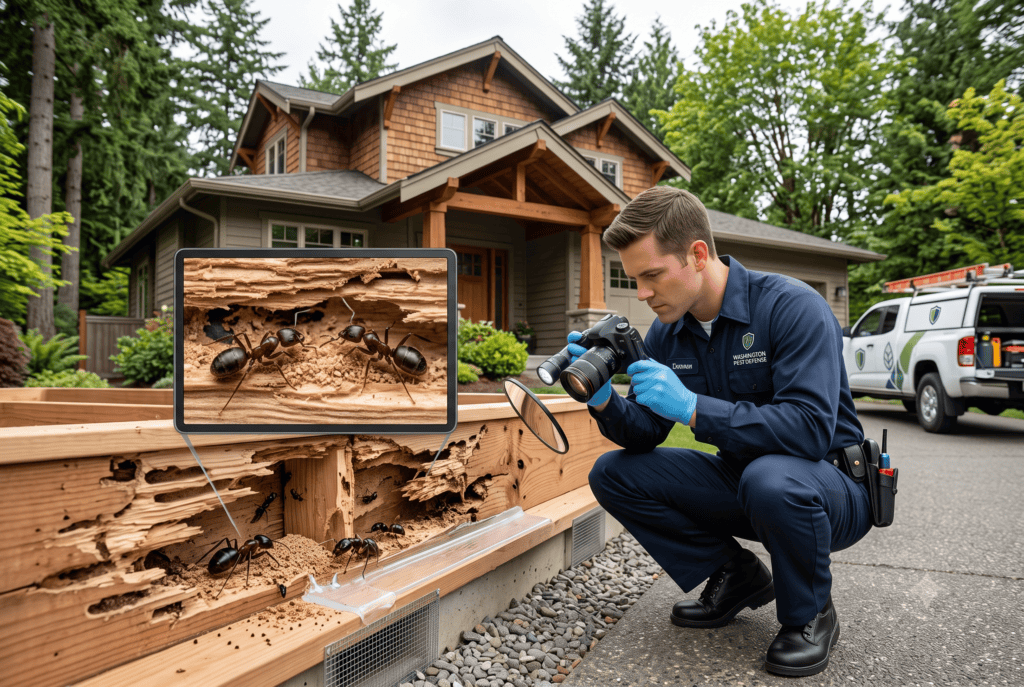
If you own a home between Tacoma and Olympia, chances are you have older siding, a few mature trees, and a crawl space that holds onto moisture during the wet months. Those are exactly the conditions carpenter ants look for, and most homeowners never think about them until one shows up on the kitchen counter. That’s usually the moment people start searching for pest control or pest exterminators without necessarily knowing what brought the ants inside in the first place.
Carpenter ants aren’t just a nuisance. Washington State University classifies them as a wood-destroying pest, though the damage looks different than most people assume. Unlike termites, they don’t eat wood; they chew through it to carve out space for their nests.
For homeowners across Tacoma, Puyallup, Gig Harbor, Lakewood, Lacey, and Olympia looking into carpenter ant removal, understanding that distinction is the first step toward catching a problem early, before it becomes a repair bill.
Why Are Carpenter Ants a Problem?
Carpenter ants get their name honestly, excavating wood to build their nesting galleries. In Washington, they typically appear solid black or a mix of red and black. According to the Connecticut Department of Energy and Environmental Protection, worker ants generally measure 1/4 to 1/2 inch, while winged reproductive ants can reach 1/2 to 3/4 inch, noticeably larger than the small ants most people see indoors.
Size isn’t really the concern, though. Where the colony has settled is. A carpenter ant infestation almost always involves two different kinds of nests working together, and knowing the difference changes how you read what you’re seeing indoors.
| Nest type | Typical location |
| Main colony | Outdoors: a stump, log, or dead tree |
| Satellite nest | Indoors: wall voids, insulation, structural wood |
The EPA notes that a single colony may branch into as many as eight satellite nests, and that carpenter ants tend to be most active after dark. So a few ants at night don’t necessarily mean the main colony is behind your wall. It may simply be a satellite outpost, with the real nest sitting somewhere out in the yard.
Why moisture deserves your attention
Carpenter ants gravitate toward wood that’s already softened by moisture, and that softening tends to happen in the same handful of spots on most properties. A few conditions come up again and again:
- Leaking gutters or roof valleys
- Damp, poorly ventilated crawl spaces
- Wood siding or trim in direct contact with soil
- Areas where water pools after rain
The EPA’s guidance on ant management points to fixing leaks, replacing moisture-damaged wood, and trimming vegetation back from the house as the go-to remedies. The ant is often a symptom; the moisture is usually the real story, easy to miss when only the visible ants get treated.
Why this matters in Washington
The South Puget Sound offers plenty of what carpenter ants want: older tree lines, aging stumps along property borders, and crawl spaces that hold moisture longer than newer construction. That doesn’t mean every home has a problem, but it does mean anyone searching for carpenter ant removal or pest control in areas like Lakewood, Auburn, and Tacoma, WA, should look for a provider who addresses the underlying conditions, not just the ants on the surface.
How to Spot a Carpenter Ant Infestation
Carpenter ants rarely make a dramatic entrance. It usually starts small: one ant, then a few more weeks later, then a pattern you finally notice.
Signs worth investigating
| What you’re seeing | What it may indicate |
| Large ants indoors | Likely carpenter ants, not common household ants |
| Ants showing up repeatedly | A possible established trail or nearby nest |
| Sawdust-like debris | Wood being excavated for a nest |
| Winged ants indoors | Possible sign of colony activity |
| Faint sounds at night | Consistent with carpenter ants’ nighttime habits |
WSU points to piles of sawdust-like material near entrance holes as one visible sign of an established colony, though not every sawdust pile means carpenter ants, so correct identification still matters.
Quick tip: Don’t rely on size or color alone. Washington is home to several ant species, and it’s easy to mistake one for another.
Spring can bring the problem into view.
Connecticut DEEP notes that winged reproductive ants generally signal a colony already at least three years old, a sign that visible activity is often the tail end of a longer timeline. WSU also reports that mating swarms in Washington typically occur from April through early June, so winged ants indoors during spring are worth taking seriously.
Where Do Carpenter Ants Hide?
Carpenter ants aren’t interested in making themselves easy to find, and the ants you spot may only be foraging far from the actual nest. Connecticut DEEP notes that carpenter ants can travel up to 100 yards from their nest while searching for food, which is one reason the source of an infestation isn’t always where the activity appears.
On most properties, the nest tends to turn up in one of these spots:
- Damp or decaying wood
- Wall voids and insulation
- Crawl spaces and attics
- Tree stumps and rotting logs
- Dead sections of trees
- Woodpiles stacked close to the house
A property’s layout tells its own story. A Lakewood home with mature landscaping may carry different risk factors than a newer build in University Place, and an older Tacoma property might have concealed moisture a quick glance won’t reveal.
Look beyond the room where you see the ants.
If ants are showing up near a kitchen window, it’s worth considering what’s on the other side of that wall rather than focusing only on the window itself. Exterior trim, a tree branch brushing the siding, or a neglected gutter can all be part of the picture, which is why professional identification helps.
Long Pest Control, Inc. offers carpenter ant control as part of its pest control services, with technicians trained to identify the source of an infestation and recommend a suitable treatment plan.
What Causes Carpenter Ant Problems?
Carpenter ants don’t show up at random. Their presence usually points to something specific about the property, and the culprit tends to be one of a few repeat offenders that show up on inspection after inspection.
| Common cause | Why it matters |
| Moisture (leaking gutters, roof issues, damp crawl spaces) | Creates exactly the softened wood conditions ants favor |
| Nearby deadwood (stumps, woodpiles against the house) | Gives ants a staging ground close to the structure. |
| Vegetation touching the home | Acts as a bridge from the yard straight to the siding |
| Hidden structural moisture | Builds quietly until ant activity is hard to ignore |
The EPA recommends fixing leaks and replacing moisture-damaged wood, while WSU points to removing stumps, rotting logs, and touching vegetation as some of the most effective prevention steps. None of these fixes require major renovation, just consistent upkeep over time.
How Can You Prevent Carpenter Ants?
You can’t control everything about your property, but you can make it far less appealing to carpenter ants. A few consistent habits make the biggest difference, and none of them require special equipment:
Around the exterior:
- Keep branches and shrubs from touching the house
- Remove rotting stumps and logs
- Store firewood away from exterior walls
- Avoid wood-to-soil contact
- Keep gutters clean
Inside and underneath the home:
- Check crawl spaces for excess moisture
- Look for soft or damaged wood
- Pay attention to recurring sightings
- Check window and door frames for entry points
None of these steps demand a weekend of work. The properties that stay ant-free the longest are usually the ones where small maintenance items don’t get left to pile up.
A useful way to think about prevention
| If you notice… | Consider checking… |
| Ants near a window | Nearby trim, vegetation, or moisture |
| Ants near the foundation | Stumps, wood-soil contact, landscaping |
| Activity near a crawl space | Ventilation, moisture, or damaged wood |
| Ants returning after treatment | Whether the underlying nest was fully addressed |
Quick tip: Start with the conditions on your property, not the calendar. A leaking gutter or damp crawl space doesn’t wait for spring.
What about properties in Tacoma and surrounding communities?
If you’re researching carpenter ant removal in Washington, local knowledge genuinely helps, since surrounding property conditions matter as much as the ants themselves.
Long Pest Control serves Tacoma and the surrounding areas, including Puyallup, Gig Harbor, Federal Way, University Place, Auburn, Lacey, and Olympia, with carpenter ant control listed among its services, which is relevant if you’re searching for carpenter ant removal.
We also offer preventative pest control on a 90-day schedule, addressing current pests on the first visit and preventing their return on subsequent visits, a structure that tends to matter more than a single treatment for homeowners who’ve dealt with recurring ant problems.
Before a Small Ant Problem Becomes a Bigger Property Concern
Carpenter ants are easy to dismiss because the first sign is usually small: one ant on the counter, a bit of debris under a piece of trim, nothing that looks urgent. But in Washington, they’re recognized as a wood-destroying pest, and their presence can indicate moisture or wood damage that’s worth addressing sooner rather than later.
If you’re seeing repeated activity around damp areas, crawl spaces, or mature landscaping, have someone take a closer look before the signs become impossible to ignore. Long Pest Control, Inc. has served the South Puget Sound since 1979, and homeowners searching for pest control companies in Tacoma, Puyallup, Gig Harbor, Federal Way, University Place, Auburn, Lacey, and Olympia, WA can rely on us for our professional carpenter ant control, rodent control, crawl space cleanouts and repairs, tree and shrub spraying, and preventive pest control services. If you’re comparing pest exterminators or simply looking for a reliable pest control company, reach out to Long Pest Control, Inc. today at
