
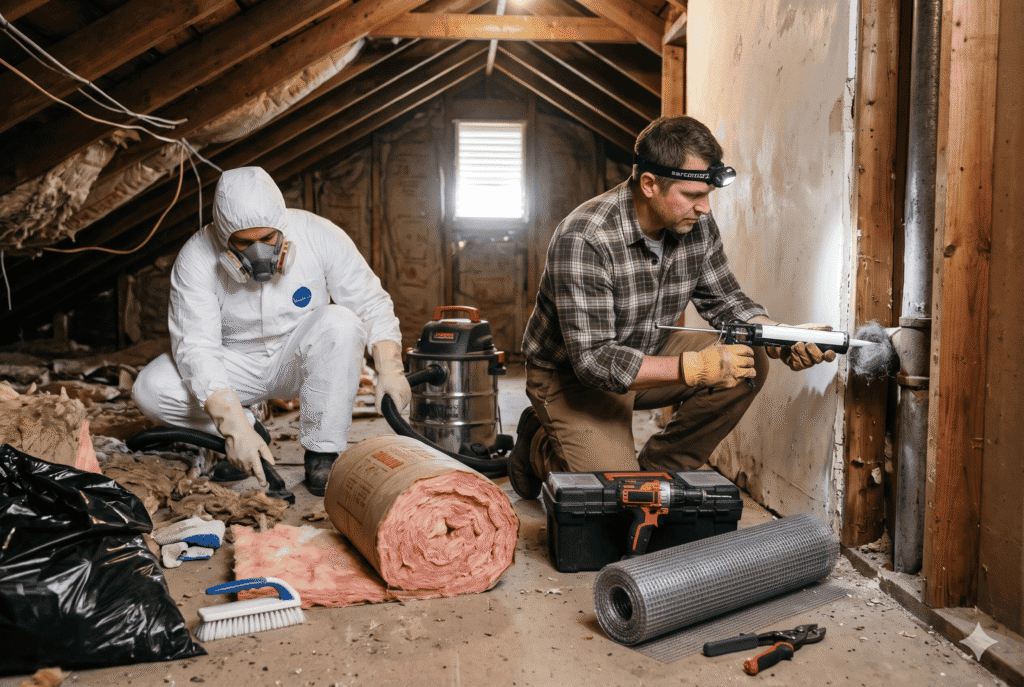
A mouse can slip into a home through a hole the size of a dime, and the droppings and nesting material it leaves behind can carry hantavirus long after the animal is gone. That is the part of an infestation few people hear about: removal ends the intrusion, but cleaning, repairs, and sealing decide whether it stays ended.
For homeowners across Pierce, South King, and North Thurston counties, the questions often begin once the rodents are gone. After rat removal, homeowners in Tacoma, Puyallup, Federal Way, and Gig Harbor may still be left wondering what needs cleaning, whether insulation needs replacing, and how the animals got inside. In Tacoma’s North End, Puyallup’s South Hill, Lakewood, University Place, and surrounding areas, a common concern after rodent removal is whether anything around the yard or roofline could let them back in.
This guide explains what to check next, which repairs may be needed, and how to reduce the chances of another infestation.
What Should You Do Immediately After Rodent Removal?
Resist the urge to scrub everything at once. Start with a calm, orderly review of the property.
1. Confirm that rodent activity has stopped
A quiet house is not always an empty one, because rats and mice can linger in wall voids, attics, and crawl spaces. King County health guidance says that if no rodents are caught and no new signs appear after a week, the active infestation has likely been eliminated. Treat that as a monitoring benchmark rather than a guarantee.
Watch for these signs:
- Fresh droppings near cabinets, baseboards, or appliances
- New gnaw marks on packaging, wood, or plastic
- Shredded paper, fabric, or insulation
- Scratching or movement after dark
2. Identify areas that need attention
Walk through the whole property and note where activity occurred before you move or clean anything.
| Area | What to look for | Next step |
| Kitchen and pantry | Droppings along shelves, torn cereal boxes or chip bags | Set contaminated food aside and wipe down shelves before restocking |
| Attic and crawl space | Flattened or stained insulation, shredded nesting material | Check how far it spreads before anyone starts cleaning |
| Garage and storage | Chewed cardboard, gaps where the wall meets the floor | Clear out boxes you no longer need and trace the gaps to the outside |
| Utility openings | Frayed wires, gnawed edges around pipes and cables | Book the right tradesperson for repairs |
| Exterior foundation | Small burrows, loose or torn vent screens | Close each opening once you are sure nothing is left inside |
Quick tip: Photograph visible damage before you remove anything. The images help you track repairs and explain the situation to a technician or contractor.
3. Treat contaminated areas as a health concern
Rodent droppings, urine, and nests can carry hantavirus, and people become ill by breathing in dust stirred up from them. According to the same King County sheet, symptoms can begin one to eight weeks after exposure, which is why it advises against sweeping or vacuuming. Heavy contamination, or waste inside ventilation systems, calls for professional guidance.
With the review complete, you can begin cleanup with a clear plan.
How Do You Clean Your Home After a Rodent Infestation?
A kitchen can look spotless while contamination lingers behind appliances and inside drawers, so the method matters as much as the effort.
Follow the right cleanup procedure.
For limited contamination on hard surfaces, King County recommends these steps:
- Ventilate: open doors and windows for at least 30 minutes before you start.
- Protect yourself: wear rubber or plastic gloves.
- Soak: wet droppings, urine, and nests thoroughly with 1½ cups of bleach per gallon of water, or with a disinfectant used as the label directs.
- Remove: collect the material with paper towels and seal it in a covered trash can.
- Disinfect: mop or sponge nearby floors, counters, and cabinets.
- Wash up: clean your gloved hands, remove the gloves, then wash with soap and water.
Never mix bleach with ammonia.
What should you do with food, clothing, and stored belongings?
Not everything has to go. The goal is to separate what can be cleaned safely from what cannot.
| Item | Keep or discard | How to handle it |
| Chewed or exposed food | Discard | Check neighboring packages too |
| Glass and metal containers | Keep | Disinfect the surfaces |
| Washable clothing and bedding | Keep | Hot water and detergent |
| Upholstery and carpet | Case by case | Steam clean, or replace if heavily soiled |
| Cardboard boxes | Discard | Move contents into sealed bins |
Garages deserve extra attention. Boxes of seasonal decorations stacked against a garage wall are a good example, so households arranging rat removal in Federal Way, Auburn, and Puyallup should sort stored items with the table above once the work is done.
What Kind of Damage Can Rats and Mice Leave Behind?
Damage often shows up only after the animals are gone because most of it hides in places nobody looks.
1. Chewed wiring and electrical components
Gnawed insulation on cables can create an electrical hazard, so treat it as more than a cosmetic issue. Have a qualified electrician assess anything suspicious, especially near the panel.
2. Contaminated or disturbed insulation
Attic and crawl space insulation absorbs droppings, urine, and nesting material. Affected sections may need replacing, but they should not be pulled apart until the safest approach is clear.
3. Holes in walls, floors, and other building materials
Rodents widen existing gaps and chew through softer materials to reach food and shelter. Baseboards, wall openings, and utility penetrations all deserve a close look.
4. Hidden contamination in crawl spaces and utility areas
Crawl spaces hide waste and nesting sites better than any other part of a house. Long Pest Control, Inc. offers crawlspace cleanout and repairs, including removing old vapor barriers and damaged insulation, installing new 6mm black plastic, deodorizing the space, setting traps, and returning about a week later. Homeowners seeking rodent removal in Gig Harbor, Lacey, and Olympia should have the crawl space checked before the job is considered complete.
Which repairs should take priority?
Not every repair is equally urgent. This table sorts what you are likely to find from the most pressing to the least.
| Finding | Recommended response |
| Wiring with exposed copper or chewed insulation | Have a licensed electrician inspect it before you rely on that circuit again |
| Insulation stained or matted with droppings | Remove and replace it, using the same protective steps as any other cleanup |
| Gaps around pipes, vents, or the foundation | Close them with rodent-resistant materials such as hardware cloth, or steel wool with caulk |
| A musty or sour smell that lingers | Trace it to its source behind the wall or under the floor rather than covering it up |
| New droppings after cleanup | Treat it as a sign that rodents are back and book a follow-up inspection |
Pest control addresses the rodents, while electrical and structural work may need separate tradespeople. Long Pest Control, Inc. itself refers foundation, roof, window, and siding repairs to a licensed contractor.
How Do You Prevent Rodents From Returning After Removal?
Prevention rests on three things working together: access, food, and shelter.
1. Seal the openings rodents use to get inside
Seattle & King County notes that mice can squeeze through a hole the size of a dime and rats through one the size of a quarter. It suggests sealing gaps with ¼ inch hardware cloth, caulk, or steel wool. Confirm that no rodents remain inside before you close a gap, so none are trapped in a wall.
| Entry point | Common problem | Suitable seal |
| Pipe and cable openings | Gaps around utilities | Steel wool with caulk |
| Foundation and crawl space vents | Torn or oversized screens | ¼ inch hardware cloth |
| Doors and garage | Worn bottom seals | Replacement door sweeps |
| Eaves and rooflines | Branches touching the house | Trim back and close gaps |
Long Pest Control, Inc. also offers exterior exclusion work, where technicians record entry points and conditions that attract pests, then provide a diagram with photos and a bid for repairs.
2. Remove the food and water that attract rodents
- Store dry food, pet food, and birdseed in lidded containers
- Clean crumbs from beneath appliances and inside cupboards
- Use garbage cans with secure lids
- Fix dripping faucets and leaking pipes
- Collect fallen fruit and manage compost carefully
3. Make the exterior less inviting
Roof rats climb trees, fences, and cables to reach a home’s upper levels, so keep branches trimmed back and shrubs away from the walls. Store firewood off the ground and inspect sheds alongside the main house. On leafy lots, overgrown cover can lure rodents in, which matters for anyone arranging rat and rodent removal in Lakewood, Auburn, Lacey, WA, and beyond.
4. Continue monitoring after the initial treatment
Recheck previously affected areas on a regular schedule. Long Pest Control, Inc. describes a quarterly preventative program that handles current pests on the first visit and returns every 90 days, with tamper-resistant bait stations placed around the exterior for rodent prevention.
Post-removal prevention checklist
- Inspect the kitchen, pantry, garage, attic, and crawl space
- Check foundation gaps, vents, and utility penetrations
- Store food and pet supplies in secure containers
- Clear clutter and potential nesting material
- Look for new droppings or gnaw marks
- Arrange repairs for wiring, insulation, or building materials
- Call a professional if activity returns
When should you seek professional help?
Call again when signs persist, entry points are hard to locate, or activity spreads across several areas. Long Pest Control, Inc. runs its active rodent program in at least three visits: the initial inspection, a one-week follow-up, and a one-month follow-up. Homeowners seeking rat and rodent control in Tacoma, University Place, Puyallup, WA can ask about that schedule, and same-day or next-day appointments may be available.
How Long Does It Take to Recover From a Rodent Infestation?
No single timeline fits every home, because recovery depends on how far the infestation spread and how much damage it left behind.
| Recovery stage | What shapes the timeline |
| Confirming removal | Number of rodents, areas affected, new signs |
| Cleaning and disinfection | Amount of waste, access, type of material |
| Property repairs | Severity of damage to wiring, insulation, and walls |
| Sealing entry points | Number and location of gaps |
| Ongoing monitoring | Whether any signs return |
A small, localized problem may wrap up quickly, while an attic, crawl space, and several rooms take considerably longer. Two households on the same street can recover at very different speeds, whether they need professional rat and rodent removal. Thorough cleanup, sound repairs, and steady observation matter far more than a house that merely looks normal again.
A Cleaner Home Starts With Lasting Rodent Prevention
Recovery after rodents comes down to four habits: clean safely, repair promptly, seal every entry point, and keep watching. Long Pest Control, Inc. has served the southern Puget Sound since 1979 as a licensed, bonded, and insured company, and its technicians are trained in Integrated Pest Management, with prevention as the first line of defense.
For rat and rodent removal in Olympia, Lacey, Federal Way, Auburn, Puyallup, Lakewood, Tacoma, Gig Harbor, University Place, and the surrounding communities, our team provides inspections, trapping and bait stations, exterior exclusion work with a diagram and photos, crawlspace cleanout and repairs, and quarterly preventative visits every 90 days. Call us at 253-565-8228 to schedule your inspection and give your home the follow-through it deserves.
