Introduction
At this very moment, there could be thousands of insects in your walls, chewing away at the wood that holds your home together, and you won’t hear a thing until a beam sags, a floor buckles, or a door frame crumbles at the touch. Termites and carpenter ants don’t announce themselves. They work in shifts, in darkness, inside the structural wood most homeowners never think to inspect, until the damage is already catastrophic. That’s not the worst-case scenario in the moist, woodsy climate of the Pacific Northwest. It’s been something we’ve seen over and over for the past 40 years or so.
Since 1979, Long Pest Control has been the region’s trusted name in termite and carpenter ant control, built on honest assessments, fast response, and treatments that actually reach the source.
This blog breaks down the early signs of termite damage and early signs of carpenter ant damage, how to tell them apart, where to check in your home, and when professional intervention becomes non-negotiable.
Termites vs. Carpenter Ants: Why Both Are Serious
Wrong identification means wrong treatment, and while you’re treating for the wrong pest, the right one keeps eating. Knowing what termite vs carpenter ant damage actually looks like up close is what separates a resolved infestation from a recurring one.
| Termites | Carpenter Ants | |
| Wood relationship | Eat it | Tunnel through it |
| Preferred wood | Sound or moist wood | Moist, softened wood |
| Frass appearance | Oval pellets | Coarse sawdust + debris |
| Mud tubes | Yes | No |
Early Signs of Termite Damage Homeowners Miss
The early signs of termite damage are designed by nature to go unnoticed, which is exactly what makes them dangerous.
1. Mud Tubes Along Your Foundation
Subterranean termites travel in pencil-thin mud tubes of soil to wood to stay moist. If you see these along your foundation or crawl space walls, you almost certainly have an active colony.
2. Hollow-Sounding Wood
Knock on your baseboards, door frames, or wooden beams. Hollow-sounding wood termites have eaten out, producing a dull, papery thud instead of a solid knock, for what looks intact from the outside may be completely excavated within.
3. Discarded Wings Near Windows
Termite swarmers shed equal-sized wings immediately after mating. Clusters near windows or light fixtures, particularly in spring, mean a colony is nearby, reproducing and growing.
If your home is older than 15 years and has a crawl space, the question isn’t whether termites have found it; it’s how far they’ve gotten.
Early Signs of Carpenter Ant Damage to Watch For
How to spot carpenter ant damage comes down to two things: what they leave behind and what they sound like inside your walls.
1. Carpenter Ant Frass in the House
Carpenter ant frass in house settings looks nothing like termite frass. It’s coarse, sawdust mixed with dead insect parts and soil, and accumulates near baseboards, window frames, or structural wood. If you’re finding it, a colony is actively excavating nearby.
2. Rustling Sounds After Dark
Carpenter ants are nocturnal. Put your ear to the wall where you think you hear something. That faint, dry rustling inside is a colony at work, not a house settling. Most homeowners shrug this off. Most homeowners dismiss this. That dismissal is costly.
Termite Damage vs. Carpenter Ant Damage: How to Tell the Difference
Misidentifying the pest means applying the wrong treatment while the real infestation keeps growing. The distinction between termite vs carpenter ant damage is visible, if you know what to look for.
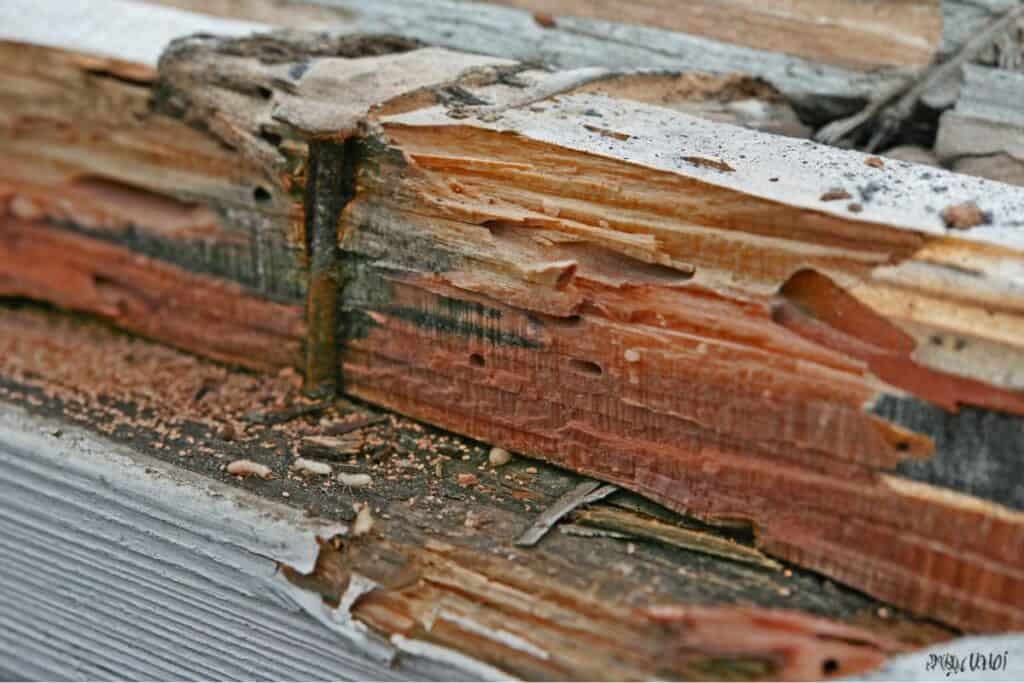
Termite damage looks rough and layered, with galleries packed with mud or soil. Carpenter ant damage is clean, smooth-walled, and almost surgical in appearance. How to spot termite damage versus how to spot carpenter ant damage gets straightforward once you open the wood, but when neither frass nor mud tubes are visible, a professional termite and carpenter ant inspection is the only reliable answer.
High-Risk Areas in and Around Your Home
Wood-destroying insect damage in home structures almost always starts in the same places, where moisture concentrates, and wood stays damp longest.
1. Crawl spaces: Dark, poorly ventilated, and consistently damp, are ideal for both species.
2. Roof eaves and attic beams: Rain exposure weakens wood here before any interior sign appears
3. Window and door frames: Water infiltration softens wood and invites carpenter ants first
4. Decks with soil contact: Direct ground contact is an open invitation for subterranean termites
5. Firewood stored against the house: One of the most common ways carpenter ants migrate indoors
In areas like Lakewood, WA, Lacey, WA, and Puyallup, WA, sustained rainfall makes crawl space moisture the most consistent driver of both termite and carpenter ant activity we encounter.
Simple Homeowner Checks You Can Do Safely
These checks take under 30 minutes and can reveal a problem months before it becomes a structural crisis.
1. Knock firmly on baseboards, door frames, and exposed beams.
2. Walk your foundation perimeter, looking for pencil-thin mud tubes near downspouts and shaded corners.
3. Crouch beneath windowsills and check baseboards for frass. Carpenter ant frass in house settings looks coarse and debris-filled, unlike the uniform oval pellets termites leave.
4. Press across the flooring near bathrooms, kitchens, and exterior walls; soft or spongy patches deserve immediate attention.
5. Step outside after dark with a flashlight, carpenter ant foraging trails along siding and fence lines are far easier to spot than most homeowners expect
Do this twice a year. Early spring catches colonies before peak activity. Fall catches late-season expansion before insects overwinter inside wall voids.
When It’s Time to Call a Professional
Call immediately if mud tubes reappear within days of removal, if carpenter ant frass in house areas is appearing in multiple rooms, if swarmers are emerging from inside the home, or if tapping reveals widespread hollow-sounding wood across structural areas. At this point, the colony isn’t new, and it isn’t small.
Long Pest Control serves Federal Way, WA, Auburn, WA, University Place, WA, Gig Harbor, WA, Tacoma, WA, and surrounding communities with same-day and next-day service. Our technicians identify the species, map the infestation’s extent, and explain every step before any treatment begins.
Treatment and Repair: What to Expect
For termites, treatment involves liquid soil barriers, targeted wood treatments, and bait systems based on species and infestation depth. Dampwood termite treatment begins with eliminating the source of moisture, because without that step, reinfestation is almost guaranteed.
For carpenter ants, treatment must reach the main colony, not just the foragers. Perimeter treatments intercept trails. Void treatments eliminate colonies nested inside walls. Treating only what’s visible leaves satellite colonies intact and active.
Our team provides an honest assessment of wood-destroying insect damage in home areas, so you know exactly what structural repairs are needed before they’re made.
Preventing Future Termite and Carpenter Ant Issues
Prevention is far less stressful than treatment, especially in high-moisture regions like Olympia, WA, Tacoma, WA, and Lacey, WA.
1. Address plumbing leaks and improve crawl space ventilation before moisture softens wood and draws both species in
2. Keep decks, posts, and siding from making direct soil contact; ground-touching wood is an open termite invitation.
3. Store firewood elevated and well away from the structure, as it functions as a staging ground for carpenter ant colonies moving indoors.
4. Seal cracks around windows, doors, and utility entries that carpenter ants use to scout and enter.
5. Cut back branches touching your roofline; they serve as direct carpenter ant pathways into eaves and attic framing.
Our quarterly preventative program will eliminate current pests on the first visit and maintain a protective barrier with each follow-up, ensuring early signs of termite damage or early signs of carpenter ant damage never become something structural.
The Bottom Line: Small Signs, Serious Consequences
Hollow-sounding wood, carpenter ant frass in house areas, and mud tubes along the foundation are not cosmetic problems. These are structural alerts. The longer they go unaddressed, the deeper the damage and the more extensive the repair. Termite vs carpenter ant damage may look different up close, but the outcome of ignoring either is the same: a home that costs far more to fix than it ever would have to protect.
At Long Pest Control, we’ve protected homes across Tacoma, WA, Gig Harbor, WA, Puyallup, WA, Federal Way, WA, Auburn, WA, University Place, WA, Lacey, WA, Lakewood, WA, and Olympia, WA since 1979. We perform thorough termite and carpenter ant inspections, deliver targeted treatments, and address wood-destroying insect damage in home structures with the kind of honesty and precision that’s kept our clients coming back for over four decades.
Don’t wait for the floor to give. Call Long Pest Control today at +1-253-565-8228; same-day and next-day service is available, and protecting your home starts with one call.
