
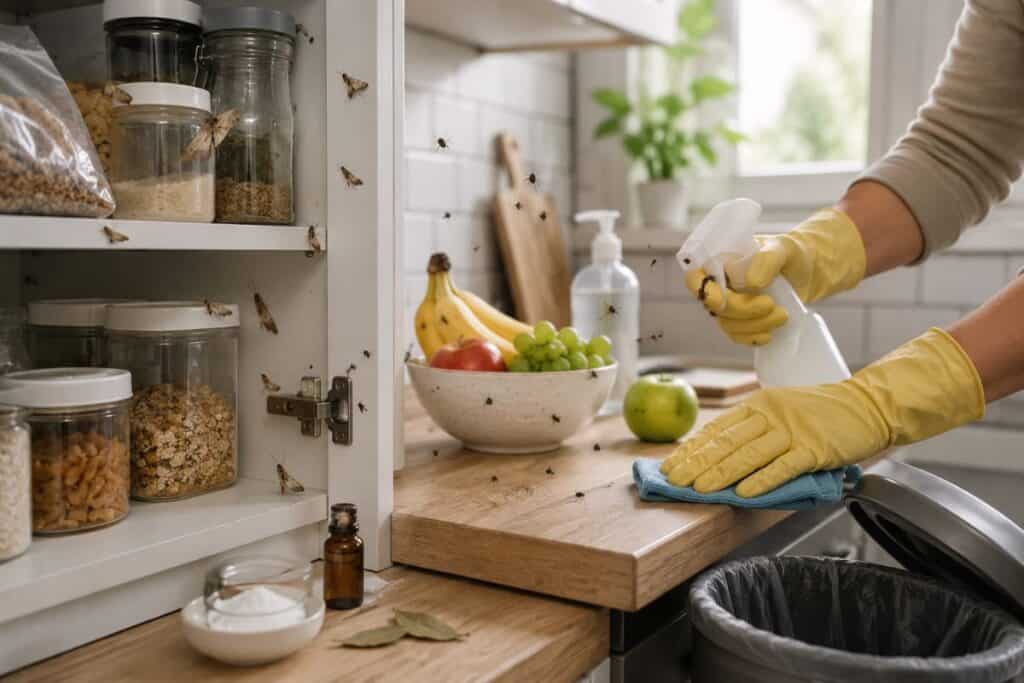
Introduction
Most people don’t realize they’ve been living with a kitchen infestation until it’s already out of hand. That bag of flour you bought last month? Pantry moths most often enter the home as eggs or larvae hidden in packaged groceries, not via windows. Those two fruit flies hovering near your sink? A single pair can produce over 1,000 offspring within just two weeks. Ignore these pests for a little while, and you’re not just dealing with an annoyance; you’re dealing with food contamination, a potential hygiene issue, and a problem that won’t correct itself.
At Long Pest Control, we’ve seen what unchecked kitchen infestations look like, and we’re here to make sure you don’t get there.
This guide walks you through every major kitchen pest control problem, from identifying the culprits to eliminating them and keeping them out. We cover pantry moths in stored food, fruit flies and drain flies in kitchen spaces, crawling invaders, safe treatment options, and when it’s time to call professionals.
Meet Your Kitchen Pests: Common Culprits
Not all kitchen pests behave the same way, and treating the wrong pest the wrong way only wastes time.
| Pest | Entry Point | What They Target |
| Indian Meal Moth | Purchased groceries | Grains, cereals, dried fruit, spices |
| Fruit Flies | Produce, open windows | Fermenting food, drains |
| Drain Flies | Drain biofilm | Standing moisture in pipes |
| Ants | Cracks, pipes, baseboards | Any exposed food or sweet substance |
| Saw-Toothed Beetles | Purchased pet food, rice | Stored dry goods |
Identification is step one. If you mistake a drain fly for a fruit fly, you’re targeting the wrong breeding area, and the infestation continues unabated.
Pantry Moths: How They Get In and What They Do
The pantry moth life cycle moves through four stages: egg, larva, pupa, and adult, and can complete in as little as 30 days or stretch to 300, depending on temperature and food availability. That range is exactly why some homeowners think they’ve solved the problem, only to find it back months later.
1. The Silent Entry
Adult pantry moths cannot eat; they have no functioning mouths. Their only work is to mate, lay eggs and die. The adult flies you see buzzing around the kitchen light are at the end of their life cycle. The real damage was done silently, long before you noticed anything.
2. What the Larvae Are Actually Doing
Look for silken webbing that causes food grains to clump together; these clumps are often more noticeable than the larvae themselves. By the time you are able to see it, the contamination has already spread through many sources of food. Under ideal conditions, there can be up to five generations of pantry moths in stored food in a single year.
Step-by-Step: How to Get Rid of Pantry Moths
How to get rid of pantry moths starts with accepting one uncomfortable truth: by the time you spot them flying around your kitchen light, the infestation is already several weeks old.
1. Pull everything out of your pantry and check each item individually. A bag of flour that looks perfectly fine from the outside can have larvae actively feeding inside it. Anything with webbing, clumping, or visible worms goes straight into an outdoor trash bin.
2. Vacuum every corner, joint, and crevice with the shelves completely empty. Follow it with a wipe-down using equal parts white vinegar and water. Moth eggs embed themselves into shelf cracks where a dry cloth won’t reach. This solution is one of the few things that actually gets in there.
3. Use your freezer for anything you’re unsure about. Three to four days at freezing temperature kills both eggs and larvae without wasting food that you’re not certain needs to be thrown away.
4. Transfer all dry goods into hard-sided airtight containers. Knowing how to clean the pantry after moths means making sure they have nothing to return to. Cardboard and thin plastic bags are not a barrier; moths work through both without difficulty.
5.Place pheromone traps inside the pantry to catch adult males and interrupt the next breeding cycle. Eggs laid before your cleanout will still hatch, so maintain consistent monitoring for at least four to six weeks before considering the problem fully resolved.
Fruit Flies and Drain Flies: Tiny Fliers, Big Frustration
These two pests are routinely confused, and that confusion keeps infestations alive. Fruit flies and drain flies look similar in the kitchen environment, but breed in entirely different places, meaning they require entirely different solutions.
1. Why Fruit Flies Are Harder to Eliminate Than They Look
Fruit flies lay up to 500 eggs in their short lifetime, and a single overripe piece of fruit can trigger a full infestation within days. What most people don’t know is the hygiene risk. Fruit flies spit saliva over food surfaces again and again and drink the mixture. This transfers bacteria and pathogens onto your kitchen counters.
2. Drain Flies: The Breeding Site You’re Missing
Drain flies breed in the gelatinous biofilm lining the inside of your pipes, a spot that standard kitchen cleaning never reaches. No vinegar trap will resolve a drain fly problem. The biofilm itself has to be eliminated.
Step-by-Step: How to Get Rid of Fruit Flies and Drain Flies
Knowing how to get rid of fruit flies in kitchen spaces means targeting the source, not just the adult insects.
1. Remove all overripe produce from countertops immediately.
2. Clean under appliances; the organic film beneath your fridge or stove is a prime breeding site.
3. Scrub drains with an enzyme cleaner; enzyme-based products break down biofilm that standard cleaners leave behind.
4. Apple cider vinegar traps: Fill a glass halfway, add a drop of dish soap, cover with plastic wrap, and poke small holes; flies enter and cannot escape
5. Fix all leaks and moisture issues; drain flies cannot survive without standing moisture.
You don’t have a fruit fly problem. You have a hygiene gap, and they found it before you did.
Ants and Other Crawling Kitchen Invaders
Ants operate on a scout-and-signal system. One scout discovers your sugar pot and leaves a pheromone trail. Within hours, hundreds of them are following the same invisible path. Standard sprays kill the scouts you see, but do nothing to the colony, and the trail remains active.
Kitchen ant infestation solutions that actually work:
1. Use bait, not spray: Worker ants carry bait back to the queen, which is the only way to eliminate the source.
2. Seal entry points: Gaps around pipes and baseboards are the primary access route into kitchens
3. Store all sweet items in sealed containers: Loosely closed honey, syrup, or sugar is an open invitation.
Saw-toothed grain beetles and carpet beetles also get in through purchased goods, especially pet food, rice and bulk grains. Check each new grocery item before you put it away.
Safe Pest Control in the Kitchen: What’s Okay
Safe pest control in the kitchen means being deliberate. Food prep surfaces require a fundamentally different approach than wall voids or under-appliance areas.
Reliable options for kitchen use:
1. Food-grade diatomaceous earth in cracks and crevices, not on food surfaces
2. Pheromone and vinegar traps, zero chemical contact with food
3. Enzyme-based drain cleaners, biodegradable and pipe-safe
4. Boric acid bait stations are placed well away from food prep areas.
Mild infestations can be effectively managed using natural kitchen pest control methods. For anything beyond that, repeated recurrence, multiple rooms affected, or suspected structural pest activity, consumer products won’t get to the root of the problem.
When to Call a Professional Pest Control Company
Some signs the situation has moved past DIY:
1. The infestation keeps returning despite thorough cleaning.
2. Pests are now appearing outside the kitchen.
3. You find damage to cabinetry or structural wood, a sign of carpenter ant activity.
4. You cannot locate the source despite repeated inspections.
Long Pest Control has been serving homeowners across Tacoma, WA, Federal Way, WA, Gig Harbor, WA, Lacey, WA, Lakewood, WA, Olympia, WA, Auburn, WA, Puyallup, WA, and University Place, WA since 1979. Our technicians don’t just treat what you see; we find where the infestation starts and kill its source. Same-day or next-day service available. Waiting is not an option when pests are in your kitchen.
Your Kitchen Deserves Better Than a Temporary Fix
Kitchen pest control is not about reacting to what you can see. It’s about understanding what’s happening inside packaging, inside pipes, and inside walls, and stopping it there. Pantry moths in stored food don’t announce themselves. Fruit flies and drain flies in kitchen environments breed in places most cleaning routines never reach. The only way to truly prevent pantry moths and fruit flies long-term is to close every entry point, every moisture source, and every food gap they depend on.
At Long Pest Control, safe pest control in the kitchen is not a checkbox; it’s the standard we have maintained since 1979. We apply our trained expertise and proven methods to every home we treat and use natural kitchen pest control methods when possible and targeted professional treatments when needed.
If you’ve spotted the signs, don’t wait. Call us at +1 253-565-8228 for same-day or next-day service. The longer pests stay, the deeper they burrow, and the harder they are to evict.
