The Real Cost of Ignoring a Small Rodent Problem in Your Home 

Table of Contents

Introduction 

A mouse behind your wall isn’t looking for a way out. It’s looking for something to chew, and biologically speaking, it has no choice; its own teeth never stop growing, and if it stops gnawing, they’ll eventually curve back into its skull. That single fact explains why a “small” rodent problem was never really small; the animal causing it is built to destroy things on a schedule it can’t control. The majority of homeowners think of a rodent problem as a minor nuisance, something a trap or two can quietly take care of over a weekend. It is, in fact, a race against biology, and the animal is always a step or two ahead of the trap. That’s why our team at Long Pest Control doesn’t treat rodent calls as a formality, but as a priority. 

This blog takes a closer look at the biology, hidden risks, and financial reality behind a rodent infestation, the parts most articles skip. By the end, you’ll understand why timing matters more than most homeowners realize. 

Why Small Rodent Problems Should Never Be Ignored 

Most homeowners judge severity by how many rodents they’ve seen. That’s not the right metric. It’s all biology and math, and both are against you as soon as rats move in. 

The Biology Behind the Behavior 

The growth rate of the rodent incisor is about 0.4 mm/day. The gnawing time of a rodent is about 2% of the daily activity, where a bite force of up to 7000 PSI is exerted. Every wire, baseboard, and stud in your home is a potential target simply because it’s there within reach. 

The Reproduction Math 

Timing compounds it further. A single pair of mice can produce dozens of offspring within just a few months, so a mice-in-house situation noticed in week one can look very different by week eight. The rodents you never see are usually the majority. 

A mouse doesn’t pause to reconsider. It gnaws because it has to, and breeds because it can, which is exactly why waiting rarely works in your favor. 

The Hidden Costs of a Rodent Infestation 

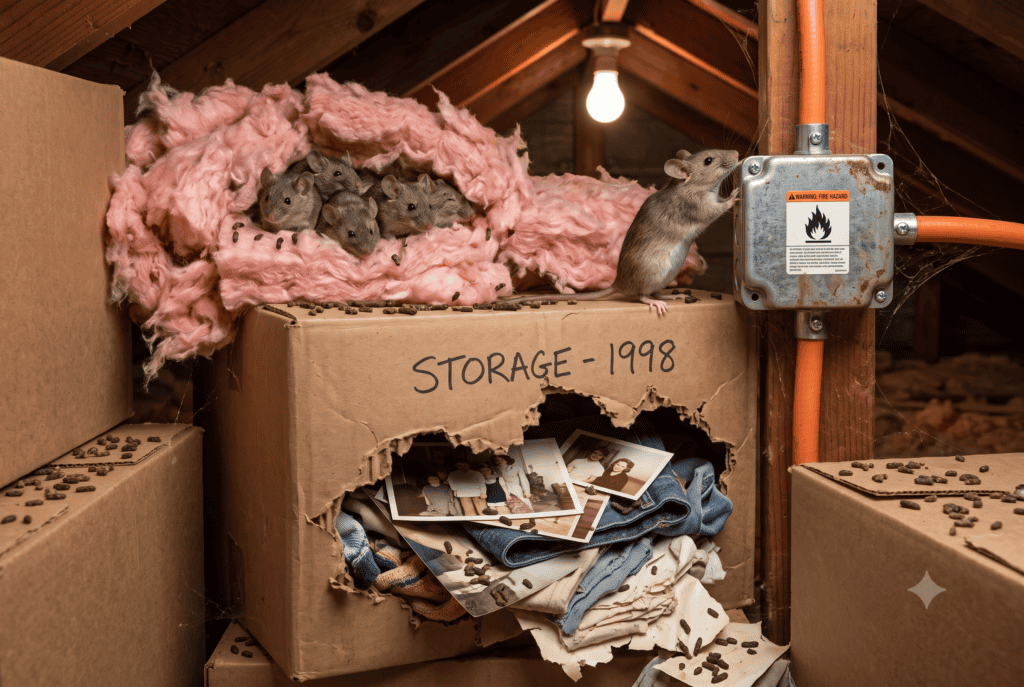
Property damage from rodents rarely announces itself. It builds quietly behind walls and under insulation, which is exactly why homeowners underestimate it until repairs are already underway. 

What Homeowners Insurance Won’t Tell You 

Here’s something most people learn too late: standard homeowners insurance doesn’t cover rodent damage because insurance companies view it as a preventable maintenance problem, not a sudden, accidental one. Typically, the exclusion will cover the cost of removal, not just repairs. In practical terms, the wiring, insulation, and structural repairs from a rat infestation can be squarely on the homeowner. 

Where the Real Damage Hides 

Rodent damage tends to concentrate in places you rarely inspect: 

  • Electrical wiring inside walls and attics. 
  • Insulation torn apart for nesting material. 
  • Ductwork and HVAC components. 
  • Wood framing, subflooring, and stored belongings. 

Researchers across North America have been studying rodent-related losses for nearly a century and have found them to be substantial and steadily increasing, following how infrequently the animals are addressed early on. 

 Waits and Watches Acts on First Signs 
Nesting sites Multiply undetected Located and removed early 
Entry points Remain open Identified and sealed 
Insurance outcome Repairs typically self-funded Damage minimized before it starts 
Timeline to resolve Extends for months Resolved in a focused visit 

Health Risks Associated with Rodents 

Homeowners underestimate this the most: the health risks from rodents go far beyond an unpleasant surprise in the pantry. 

Nationally, rodents have been linked to more than 55 different diseases, spread through droppings, urine, saliva, and the parasites that live on them. In Washington, the risk isn’t theoretical: the state records roughly one to five hantavirus cases every year, and about a third have proven fatal. 

Rodents also compromise food safety at scale. They are estimated to destroy about 20% of the world’s food supply each year, including about 4% of stored rice and grain worldwide. A rodent infestation in your kitchen doesn’t need to be large to contaminate everything it touches. 

Every visible dropping represents an animal that has already been in contact with your food, your air ducts, and possibly your family’s living space. 

Signs Your Small Rodent Problem Is Getting Worse 

Escalation usually shows up in patterns, not single incidents. Watch for: 

  • Droppings in new locations, not just one spot. 
  • Chewed wiring, wood, or plastic containers. 
  • Frequent travel paths result in grease streaks along baseboards. 
  • Scratching noises in the walls, particularly during the night. 
  • A musky odor in confined spaces that lingers. 
  • Nesting material such as shredded paper, fabric, or insulation. 

If more than one of these is present, you’re looking at an established colony that needs rodent removal, not another round of store-bought traps. 

How Professional Rodent Control Saves You Money 

Saving money here isn’t about the price of a trap. It’s about avoiding a situation where the same problem reappears every couple of months because the entry points were never addressed. 

Why DIY Traps Fall Short 

Store-bought traps remove individual rodents, but mice and rats learn quickly to avoid repeated threats. A trap deals with what’s visible; it does nothing about the gap under your siding that let the colony in, and nothing to stop the next group from finding that same opening. 

What a Professional Inspection Actually Involves 

At Long Pest Control, a rodent inspection goes beyond setting traps. Our team identifies entry points, locates nesting activity, and builds a plan around rodent proofing so the problem doesn’t return with the next cold snap. Our quarterly program follows the same logic: an initial visit clears existing activity, and each follow-up keeps new activity from taking hold. 

DIY Approach Professional Pest Control for Rodents 
Targets visible rodents only Targets the colony and its entry points 
No ongoing monitoring Scheduled follow-up visits 
Entry points often left open Entry points sealed as part of the process 
Effectiveness declines over time Designed for long-term rodent prevention 

When Should You Call a Professional Rodent Control Company? 

Most people think the right time to call is after the second or third sighting, but really the right time to call is earlier than this. Ideally, the right time to call is at the first droppings, gnaw mark, or nighttime sound. Established rodents require a different level of intervention than a fresh intrusion. 

We help homeowners across Tacoma, WAFederal Way, WAGig Harbor, WALacey, WA,act at exactly this stage, before a manageable situation turns into a structural and health concern. If you’re hearing activity in your walls tonight, that’s not something to schedule for next month. 

Act on the First Sign, Not the Tenth 

A rodent problem that may seem minor today is running against an invisible biological clock. Rodents are not getting any easier to manage over time, with the constant gnawing of ever-growing teeth, the rapid reproduction, the exposure to disease, and the fact that the insurance system usually won’t pay for the repairs. Every week you delay, they benefit. Not you. 

Long Pest Control has served property owners since 1979, and our approach to rodent control reflects decades of hands-on experience with exactly this kind of escalation. From initial inspection through targeted removal and long-term rodent proofing, our team focuses on solving the source of the problem, not just the symptoms you happen to notice. 

If you’ve heard something in your walls, seen a droppings you can’t explain, or simply want a professional set of eyes on your home before rodent season begins, don’t wait for it to grow. Call Long Pest Control today at +1 253-565-8228 and let our team handle it before it becomes a much bigger problem.